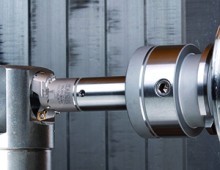
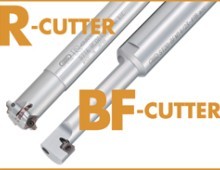
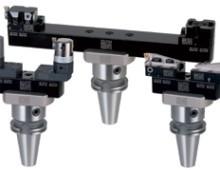
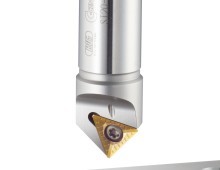
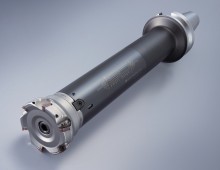
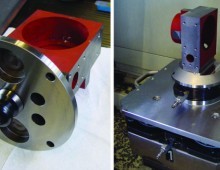
With a little knowhow and the right tools, see how you can significantly reduce cycle time by rough boring instead of performing a helical interpolation with a mill.
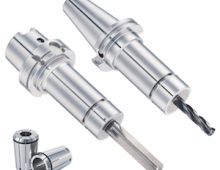
Many machine shops lack objective criteria for making toolholder purchasing decisions & most are made by price alone. However they can improve runout significantly by using the right toolholders.
The SPERONI ESSENTIA features a compact bench-top design, works with any brand of router tools and handle complex tool profiles in stone cutting with ease.
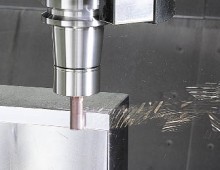
Micromachining, cutting where the volume of chips produced with each tool path is very small, is not a high-speed operation in relation to chip load per tooth. Rather, it involves a high spindle speed due to cutter diameter. The part may be physically larger, but details of the part require ultra-small profiles achieved only by micromachining. In other words, micromachining is not limited in scope to only miniature parts.
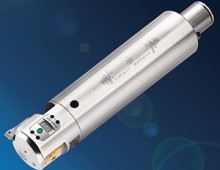
BIG DAISHOWA introduces the EWN & EWD Smart Damper - precision boring heads with a patented damping system to eliminate vibration in deep-hole finish boring.
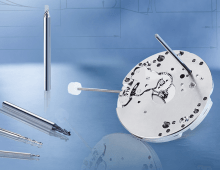
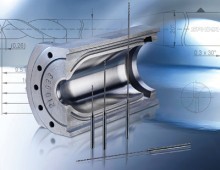
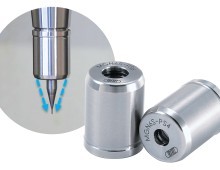
This new micro deep-hole drill from BIG DAISHOWA’s Sphinx line provides a time-saving option for creating wire EDM starter holes, averaging 5X faster per hole according to testing.
BIG DAISHOWA has introduced the new, large diameter Kaiser 318 Series - a complete tooling system supporting a variety of aluminum and steel components optimized for twin cutter rough boring, precision finish boring and precision OD turning operations.
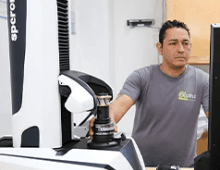
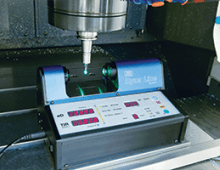
BIG DAISHOWA, a leader in premium high-precision tooling systems and solutions, has announced the release of the Dyna Line Portable, a budget-friendly, in-machine measuring device suitable for a wide variety of shop environments.
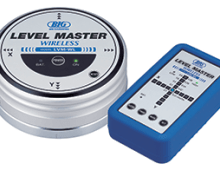
BIG DAISHOWA, a leader in premium high-precision tooling systems and solutions for the metalworking industries, announced today its new Level Master Wireless, a high precision device for the leveling of machine tool tables.