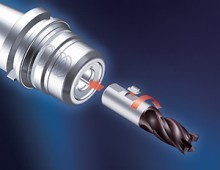
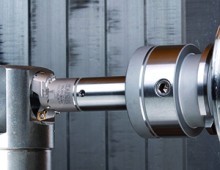
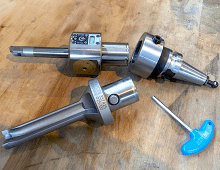
The chances of a tool slipping or pulling out in its holder during work is increasing. Here are some insights to help you select the proper holder for your work.
Aerospace is unique among industries in its thirst for component accuracy with ‘blemish-free’ precision. Unlike any other industry, anything that goes into the air has to be on spec, as the smallest imperfection in machining can adversely affect flight safety.
By using digital technology and optimized indexable inserts, Schmauser Müller Metalltechnik has increased process reliability and efficiency in fine boring, as well as increased the lifetime of its tools by a factor of three.
With a little knowhow and the right tools, see how you can significantly reduce cycle time by rough boring instead of performing a helical interpolation with a mill.
There are three particularly sensitive areas of the tool holder assembly that can experience process-affecting wear and tear and cause a cycle to change.
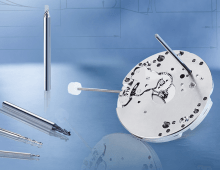
Micromachining, cutting where the volume of chips produced with each tool path is very small, is not a high-speed operation in relation to chip load per tooth. Rather, it involves a high spindle speed due to cutter diameter. The part may be physically larger, but details of the part require ultra-small profiles achieved only by micromachining. In other words, micromachining is not limited in scope to only miniature parts.
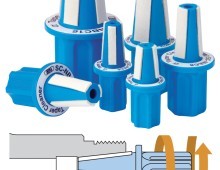
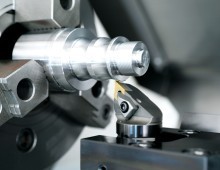
BIG DAISHOWA is expanding its range of BIG Capto tool holders with the addition of a new size, C4, which is becoming increasingly popular as a quick-change system for turret tooling on lathes.
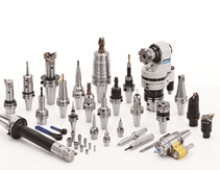
In order to take full advantage of a machine tool's capabilities, you must have the tooling to unlock a machine’s full capability. Here is some advice for making the most of a new machine tool with the right tooling.
The contract manufacturer Schittl from Deutsch Kaltenbrunn specializes in the production of one-offs and small series projects. Based on a recommendation from the multi-brand dealer Metzler, they use chucks from BIG DAISHOWA. This is their story.
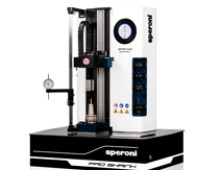
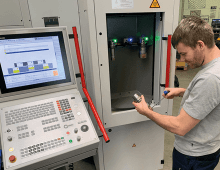
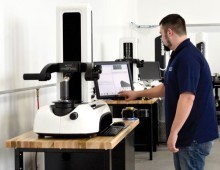
As lathes and turning machines pivot toward quick-change tooling models from traditional stick tools, tool presetters present benefits of keeping chips flying while reducing human error and increasing precision.