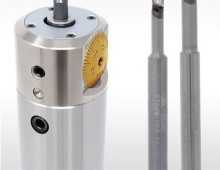
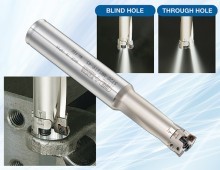
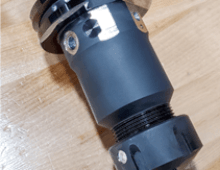
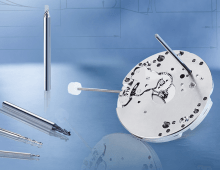
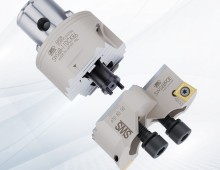
The Mini Indexable Boring Bar helps meet the increasing demand for successfully boring small parts in industries like medical and aerospace, such as machined medical implant devices and micro-sized components.
Successful shops always look for ways to differentiate and innovate for competitive advantage. Cashing in on the entirety of a tool’s life with an advanced tool management system is perhaps the most effective way to do that right now.
In order to take full advantage of a machine tool's capabilities, you must have the tooling to unlock a machine’s full capability. Here is some advice for making the most of a new machine tool with the right tooling.
With a little knowhow and the right tools, see how you can significantly reduce cycle time by rough boring instead of performing a helical interpolation with a mill.
A lot of conflicting information has circulated about balancing tools over the years. Let's clear some things up and make life a little easier for you.
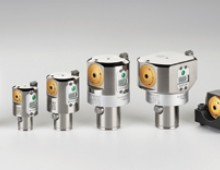
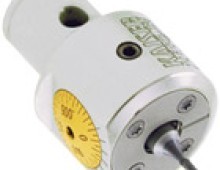
BIG DAISHOWA is expanding its offering of digital boring heads to include head sizes down to the CKB1 modular tooling connection size, which means boring down to Ø.787” for Series 310 peripheric heads, and Ø.016” for Series 112 centric boring heads.
Micromachining, cutting where the volume of chips produced with each tool path is very small, is not a high-speed operation in relation to chip load per tooth. Rather, it involves a high spindle speed due to cutter diameter. The part may be physically larger, but details of the part require ultra-small profiles achieved only by micromachining. In other words, micromachining is not limited in scope to only miniature parts.