

Latest Posts


Calculating Total Indicated Runout in Multi-Component Assemblies
Key Points
-
Learn how cumulative runout builds with each component in a modular tool assembly and impacts machining accuracy.
-
Understand how to calculate and audit Total Indicated Runout (TIR) to identify and reduce cumulative error.
-
Discover best practices for maintaining precision by managing tolerances, component quality and assembly condition.
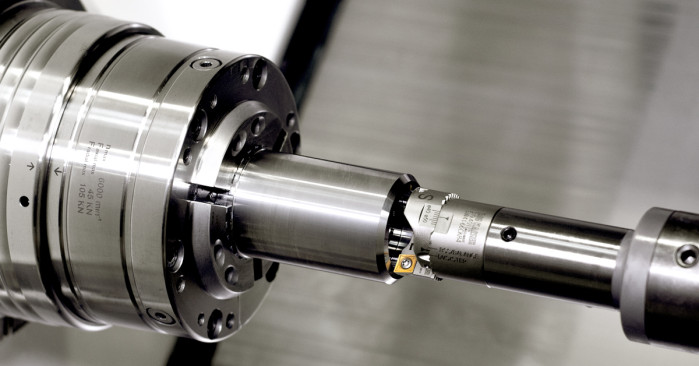
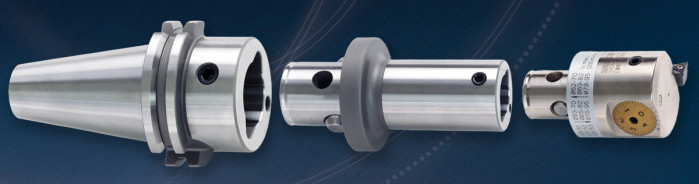
When machinists evaluate a tool holder, they typically check its published TIR spec and move on. A holder rated at 0.0001" runout sounds like a solid foundation for precision work; in isolation, it is. But the moment you build a modular assembly by adding an extension, a reducer or a collet, that number no longer speaks to what your entire assembly runs out at by the time you reach the tool tip. Understanding how stacking tolerances can lead to exponential error at the tool tip and how to calculate total indicated runout (TIR) is crucial for modular tooling precision.
Total Indicated Runout Calculation
Total Indicated Runout measures how much a rotating tool deviates from its true centerline. Manufacturers publish TIR specs for individual components under controlled conditions. Cumulative TIR is what you get at the cutting edge once multiple components are assembled together.
Each interface in the assembly introduces its own runout contribution. Those contributions add together, and they can compound far past the sum of the individual specs.
To calculate cumulative TIR, assume each component contributes its maximum published TIR and add them together. This will prepare you for the worst-case scenario. For example, suppose you're building a modular assembly with the following components:
Tool holder: 0.0001" TIR
Extension: 0.0001" TIR
Reducer: 0.0002" TIR
Collet: 0.0001" TIR
Worst-case cumulative TIR = 0.0001 + 0.0001 + 0.0002 + 0.0001 = 0.0005"
That's five times the runout of the holder alone, even with components that each carry tight individual specs. If any one of those components is worn, improperly cleaned or of lower quality, the real-world number will be even higher.
For assemblies where some statistical averaging is appropriate, such as when you have a large number of components and can accept occasional worst-case scenarios, a root sum of squares (RSS) method may be more appropriate:
Cumulative TIR ≈ √(T1² + T2² + T3² + T4²)
Using the same numbers as before as an example: √(0.0001² + 0.0001² + 0.0002² + 0.0001²) = 0.000265"
RSS gives a statistically probable result rather than the absolute worst case. For precision work, worst-case scenario is the safer calculation, especially when tolerance budgets are tight and part rejection is costly.
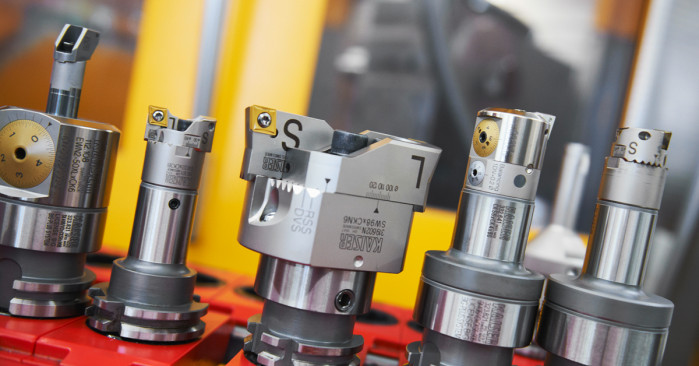
TIR Auditing for Modular Tooling Precision
Calculating theoretical cumulative TIR is the starting point. Measuring actual cumulative TIR confirms it, and it tells you exactly where your assembly is losing precision.
Build your assembly one component at a time, measuring TIR after each addition. By recording the result at every step, you can isolate each component’s contribution to the stack. However, keep in mind that TIR is directional; errors can either add up or partially cancel each other out depending on their orientation. Once the full assembly is complete, measure as close to the cutting edge as safely possible, as runout magnifies with length. Compare this final value against your requirements. If it’s out of the allowable margin, your audit identifies the biggest contributor and allows you to either replace that component or rotate it to minimize the cumulative error.
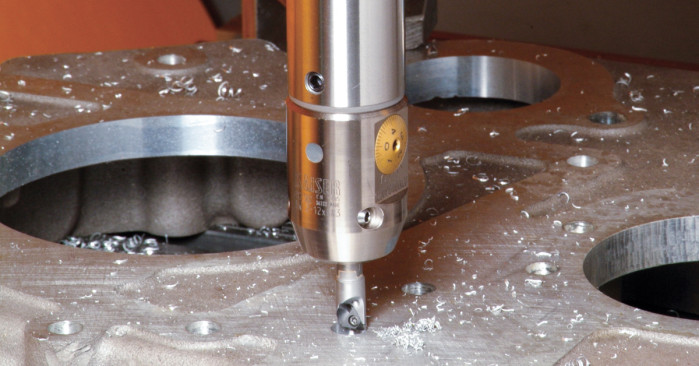
Why Cumulative Error Grows Faster than You Think
Runout doesn't just compound linearly in real assemblies; it can increase almost exponentially at the tool tip. This is due to a property that's easy to overlook: leverage.
Runout is an angular deviation measured at a specific point. The farther away from the pivot point you measure, the larger the displacement becomes. An extension also magnifies any error already present in the components behind it, because the tool tip is now farther from the spindle centerline reference. The longer the assembly, the more dramatically each component's error is amplified at the cutting edge. This is why reaching tool length with extensions and reducers impacts precision as well as geometry.
Take Care of Your Tool Stack-Up
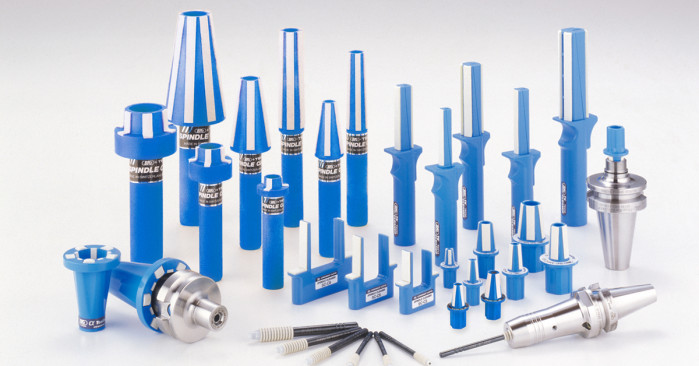
In a modular system, the quality of each connection point is where cumulative error either is controlled or allowed to grow. Contamination, wear, improperly torqued connections and subpar surface finishes all introduce additional runout at each interface.
This is why proper maintenance of every tool in the assembly is crucial. Residue in a collet bore, a nick on a taper seat or a worn reducer thread can add significant runout that won't show up in any published spec. Cleaning connection surfaces before assembly, inspecting for damage and replacing worn components are all necessary to keep a modular tool assembly performing within its TIR.
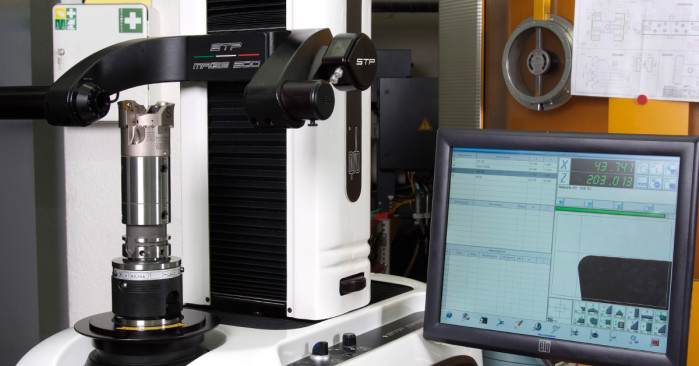
Quality Tools Make All the Difference
The components closest to the spindle matter most. An error at the holder is amplified through every downstream component before it reaches the tip. Starting with a holder ground to tighter tolerances gives the entire assembly a better baseline to build from. Starting with a lower-quality holder means every subsequent component is managing a problem it didn't create.
The same logic applies to the machine spindle condition. This is the origin point for the whole calculation before a single tooling component enters the picture.
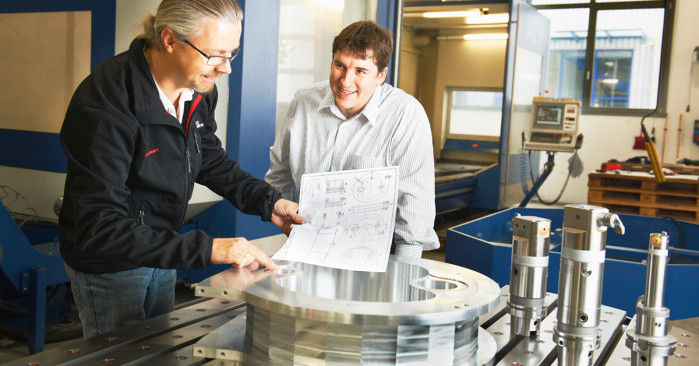
Tighten Up Your Tool Tolerances with BIG DAISHOWA
A TIR spec on a data sheet is a starting point, not a guarantee of what you'll achieve at the cutting edge. In a modular tool holder assembly, tolerances compound, angular errors multiply with length and the result at the tool tip can far exceed what any individual spec would suggest. Calculating cumulative TIR before you build, auditing it after, and using well-maintained, high-quality components keep modular tooling operations performing as intended.
Categories
Did you find this interesting or helpful? Let us know what you think by adding your comments or questions below.



Add new comment