

Latest Posts
Why Gripping Strength Alone Won't Prevent Tool Pull-Out
Key Points
-
The difference between gripping strength and axial pull-out force in milling operations.
-
How friction-based clamping reaches its limits under high-torque machining conditions.
-
When Weldon flats and dedicated locking mechanisms help prevent tool pull-out.
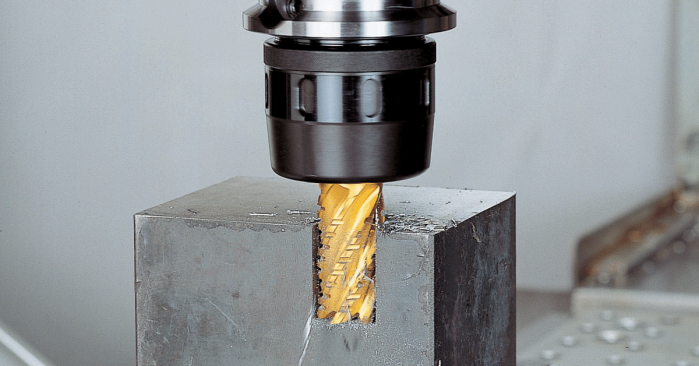
Tool pull-out is one of the most expensive failure modes in precision machining. A single ejection event can scrap a workpiece, damage a spindle and pull a machine out of production. These errors can cost thousands of dollars before factoring in downtime. Still, the most common response we see is simply to specify a chuck with a higher gripping strength rating and move on.
The problem is that gripping strength and pull-out protection are not the same thing. They are distinct mechanical properties, governed by different forces and demand different engineering solutions. More grip does not directly translate to more axial retention. In some configurations, overclamping may even work against you.
We will break down the physics behind friction-based clamping systems, where they reach their limits, what pull-out protection options like Weldon flats actually solve (and what they don't) and how to best utilize all of these concepts for an optimally stabilized high-torque machining setup.
Defining Gripping Strength and Pull-Out Force in Milling Chuck Mechanics
Let’s start with some basic definitions.
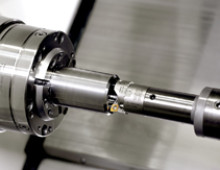
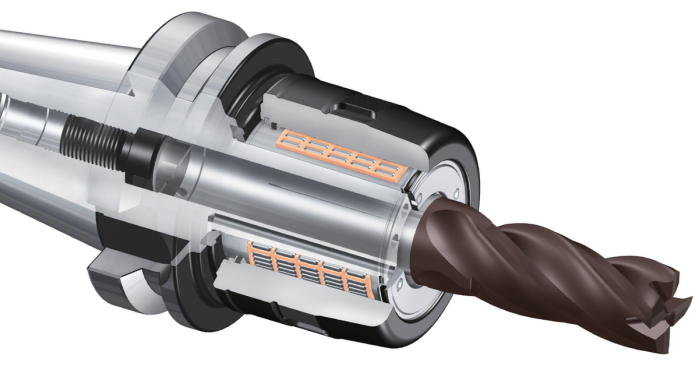
Gripping strength is the clamping force a chuck applies radially around the tool shank to secure a cutting tool in place. It resists the tendency of the tool to spin or rotate within the chuck. Gripping strength is a key performance spec for milling chucks, collet chucks, hydraulic chucks and shrink fit holders.
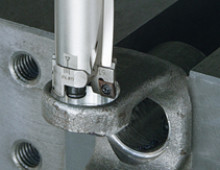
Pull-out force is the axial load acting to eject the tool from the chuck during cutting operations. It is driven by chip load, helix angle and feed rate. Pull-out force increases with higher depths of cut and heavier feed rates.
To put it simply, gripping strength is resistance to rotation, and it is delivered through radial clamping. Pull-out force is a separate axial challenge that requires its own solution, whether that is a Weldon flat or a dedicated locking mechanism. A chuck can have an excellent grip torque rating and still be highly susceptible to axial pull-out. The two serve foundationally different functions.
The Physics of Friction-Based Clamping
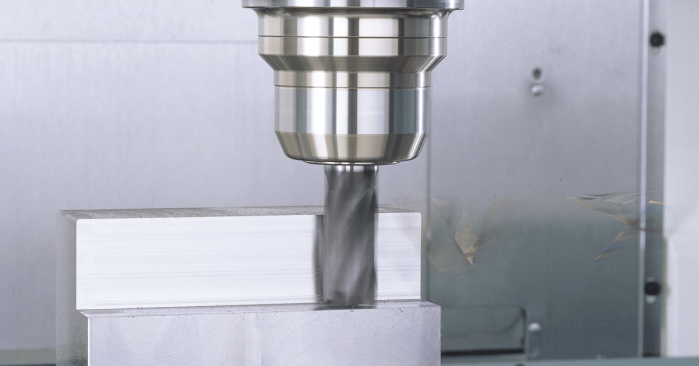
The forces acting on a cutting tool are not uniform or static. In a milling operation, each flute entering the cut generates a force spike with tangential, radial and axial components. The ratio between these components shifts with every change in direction of the cutting tool.
Tangential cutting forces come from the workpiece resisting the shearing action of the cutting tool. These forces try to rotate the tool inside the chuck, and radial clamping keeps that from happening. In conventional milling at moderate chip loads, this rotational force is the primary retention challenge. A well-specified chuck with sufficient gripping strength handles it reliably.
Axial pull-out forces are generated differently. As a helical flute interacts with the workpiece, the cutting geometry resolves part of the cutting force into an axial component that acts to draw the tool out of the chuck. The longer the flute length and steeper the helix, the larger that axial component relative to the tangential load. At the helix angles common in high-performance end mills (45° and above) the axial pull-out force is substantial, and it spikes with every tooth engagement.
For chucks that rely solely on radial clamping to resist axial movement, those spikes are the critical failure condition. Each engagement stresses the axial retention envelope. If peak force exceeds what the radial interface can hold, the tool displaces incrementally. It does not spin out immediately. By the time displacement is detectable, significant movement has already occurred.
Gripping Strength Has a Ceiling in High-Torque Machining
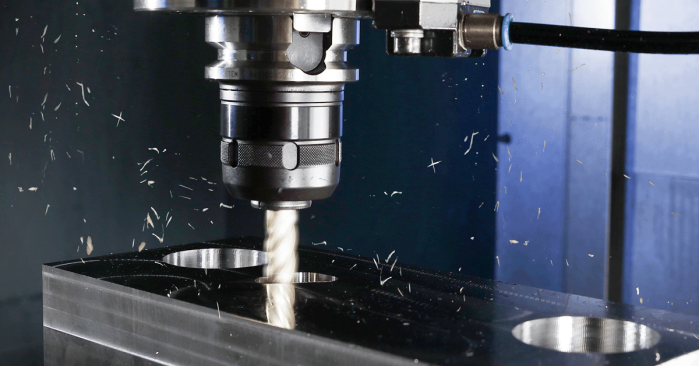
High-torque machining operations generate both high rotational and high axial forces, and both scale up with chip load and engagement. We understand the instinct to solve pull-out risk by increasing gripping strength, but doing so does not address what is actually happening on the axial side of the equation.
Axial retention in a radial clamping system is constrained by the geometry of the interface. Radial clamping force acts perpendicular to the axis of the tool. Its ability to resist axial movement depends entirely on friction at that interface, and friction has a practical ceiling set by surface conditions, shank tolerance and contact area. Increasing clamping pressure beyond that friction ceiling yields diminishing axial clamping returns while continuing to stress the shank and bore.
Pushing past that ceiling leads to increased shank stress, bore distortion and accelerated wear on both the chuck bore and tool shank. The best pull-out protection systems work with the mechanics of the interface rather than against them. They redirect force rather than simply adding more of it.
When to Utilize Weldon Flats for Tool Pull-Out Protection
So, what can you do to prevent axial movement? Often, the go-to solution is the Weldon flat. This feature addresses the axial retention problem through direct mechanical engagement. The flat allows a set screw in a side-lock holder to securely lock the tool, providing strong rotational resistance and preventing pull-out.
Locking on Weldon flats with a set screw is an advantage in certain applications. For heavy interrupted cuts, large-diameter tools and low-RPM roughing operations, the set screw provides reliable axial retention.
However, this interface carries mechanical limitations. The stress concentration at the flat creates a notch effect on the tool shank. Under cyclic loading, this accelerates fatigue, especially for smaller diameter tools. The asymmetric contact also introduces runout; because the set screw contacts only one side of the shank, the tool is displaced. At higher RPMs, the resulting imbalance becomes significant enough to affect both surface finish and spindle bearing life.
The Case for Proprietary Locking Mechanisms
Modern pull-out protection systems approach pull-out protection differently. Rather than relying entirely on friction or on a single-point set screw, they decouple axial retention from radial clamping and address each force with a dedicated engineered feature.
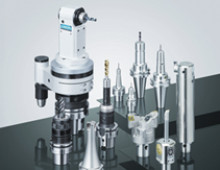
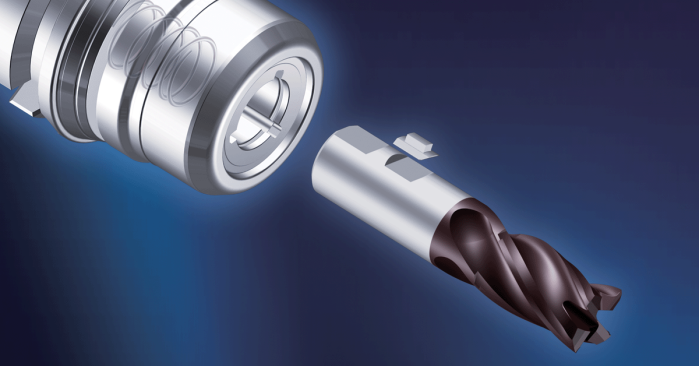
The specific implementations vary by manufacturer. In general, they all create a positive axial lock that is integrated into the chuck and shank geometry. See the MEGA PERFECT GRIP Milling non-pullout milling chuck from BIG DAISHOWA, for example.
This design combines a locking key in the Weldon flat with the high radial clamping force of a milling chuck. Axial retention no longer depends on or trades off against radial clamping pressure.
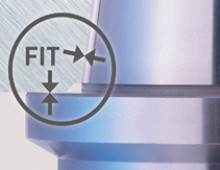
Proprietary systems also demand tighter shank tolerances. A closer fit between shank and bore means lower runout, better balance characteristics and more predictable performance at high speeds. The manufacturing precision required to make the locking mechanism work also produces a more accurate tool-to-spindle interface.
Engineer for Stability with a Precise, Strategic High-Torque Machining Setup
Gripping strength and pull-out protection are not the same property, and no amount of clamping force converts one into the other. Pull-out protection belongs in the chuck design, not in the clamping setting. Systems that treat axial retention as an independent design requirement rather than a byproduct of radial clamping deliver better tool life, more consistent runout and more predictable performance at the RPMs and chip loads that high-torque machining demands.
Choosing the right system is not about finding a higher number on a spec sheet. It is about matching the chuck's mechanical properties to the force profile of the cut. To find the right system for your operation, contact us today.
Categories
Did you find this interesting or helpful? Let us know what you think by adding your comments or questions below.


Add new comment